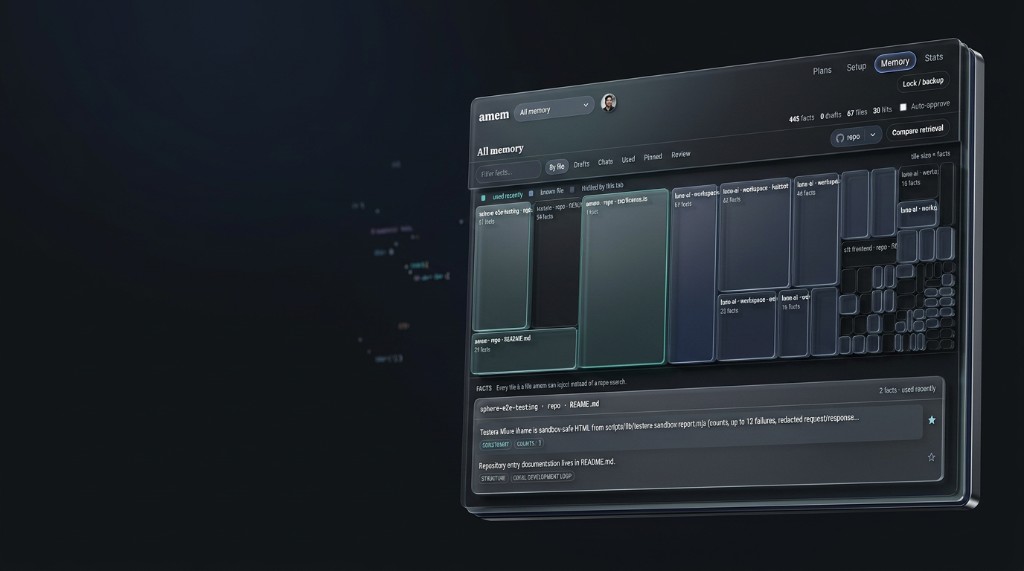
Agents forget. amem does not.
The next Cursor or Claude session starts with the constraints, gotchas, and file anchors you already paid to discover — not a cold grep of the whole tree.
Local agent memory
amem
Memory, skills, tasks, and the desktop app — all of it. Facts stay in ~/.amem on your machine. One command, then open the UI.
npx @iamem/amem setup
npm i -g @iamem/amem && amem setup
Node 20+. Then run amem ui. Source on GitHub.
What changes
The next Cursor or Claude session starts with the constraints, gotchas, and file anchors you already paid to discover — not a cold grep of the whole tree.
Memory holds what is true. Skills hold how you do it here, loaded only when relevant. Tasks are a Kanban the agent can move so follow-ups survive the chat.
amem ships no model. When a session looks like a hard-won procedure, it nudges the agent to write a skill. You approve. The next agent does not rediscover it.
The database lives in ~/.amem. The UI binds to localhost. No managed sync, no org wiki, no cloud RAG. Optional lock and encrypted local backups.
A project rule, stop hooks, and MCP tools (amem_context, amem_remember, skills, tasks). Same local DB for Windsurf, Continue, Aider, and Zed.